

I’ve spent years studying Daniel Goleman’s work on emotional intelligence. His definition stuck with me: the ability to monitor your own and other people’s feelings and emotions, then use those insights to pursue and attain goals.
Simple on paper. Profound in practice.
Here’s what most people miss: emotional intelligence isn’t just an interpersonal skill. It’s operational architecture. The invisible system that determines whether your technical capability compounds into sustainable outcomes or collapses into fragmented activity.
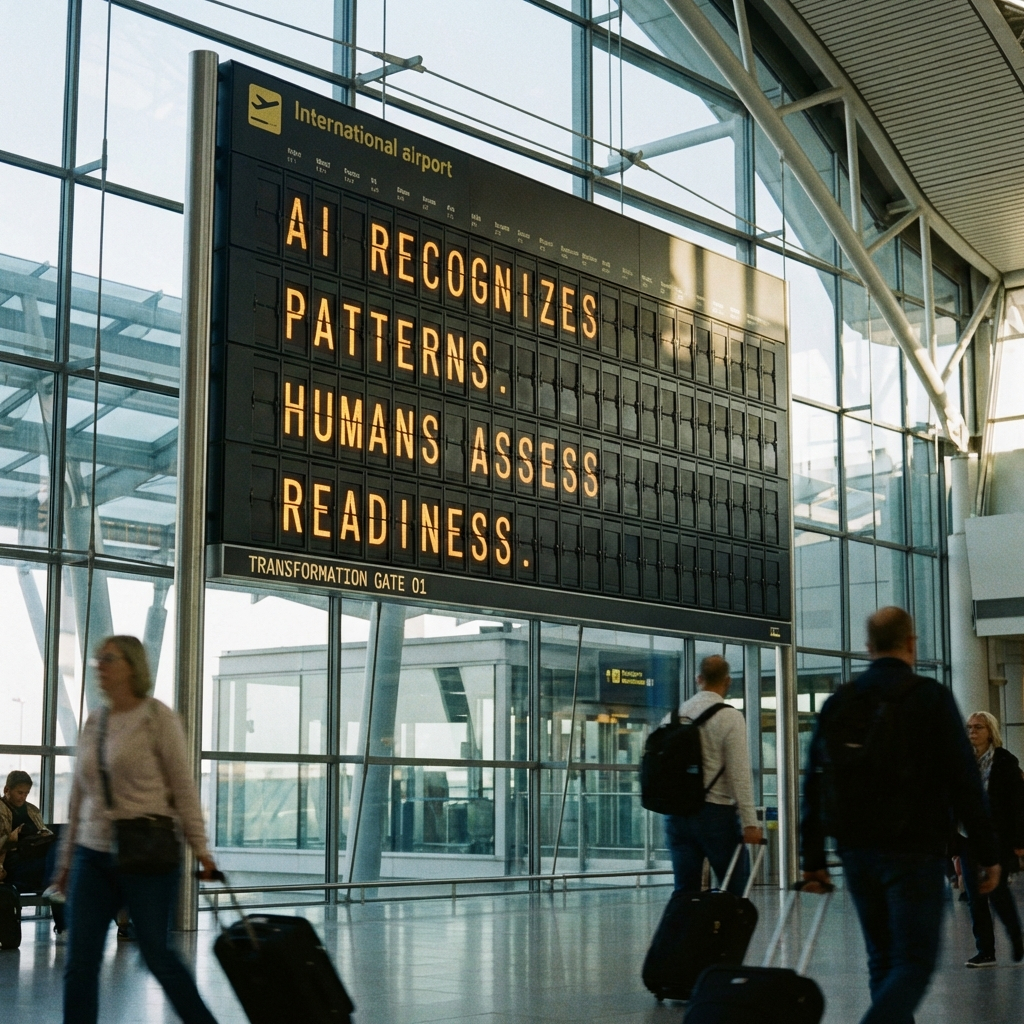
AI can mimic patterns. It can recognize facial expressions. It can process massive datasets about human behavior.
But mimicry isn’t mastery.
The Diagnostic Gap AI Can’t Cross
AI excels at pattern recognition. Feed it enough data about human behavior and it will identify trends, predict responses, suggest interventions.
What it cannot do is assess readiness.
I learned this creating psychometric tests based on emotional intelligence at university. The software could only give you something valid if you were honest in how you answered the questions. AI works with what you tell it. Humans work with what you’re not saying.
Think about the human brain for a moment. We operate from both hemispheres—left brain handling logic and reason, right brain processing emotion and creativity. When you’re present in a situation with other people, both elements play out simultaneously. You’re integrating analytical thinking with emotional responsiveness in real time.
AI is ones and zeros. Pattern recognition. Data sets.
Even though emotions and human behavior exhibit patterns AI can identify, that’s manufactured. Synthetic. It’s not the authentic integration between logical reasoning and emotional processing that happens when humans interact.
Research from Harvard Business School confirms this: human experience and judgment remain critical because AI can’t reliably distinguish good ideas from mediocre ones. Human judgment remains essential for interpreting and applying advice.
The gap isn’t what AI can’t recognize. It’s what AI can’t diagnose about psychological readiness—the prerequisite detector that determines whether technical solutions will integrate or fragment your existing systems.
Why Trust Architecture Beats Algorithmic Recommendations
You know what I call the foundation of effective knowledge transfer? The emotional win.
You need awareness of your own thoughts and emotions. You need the ability to understand those same elements in others. Without this foundation, you’re building on sand.
Here’s a scenario I see constantly: Someone walks into the workplace carrying something from home. Maybe a fight with their partner. Maybe financial stress. Maybe health concerns. They react in ways that seem disproportionate to the situation at hand.
AI can’t understand that context. Not really.
It might monitor facial expressions. It might identify micro-expressions suggesting anger or resentment. It could probably recognize patterns and suggest responses based on similar situations in its training data.
But recognizing anger isn’t the same as comprehending the complex web of experiences that created it.
A 2025 Workday study found that 82% of individual contributors believe employees will increasingly crave human connection as AI becomes more integrated into work. Only 65% of managers share that view.
That gap matters.
Where AI optimizes output, emotional intelligence optimizes impact. Results move at the speed of relationships. How quickly you build trust determines how fast teams align, how effectively knowledge transfers, how sustainable your systems become.
Algorithmic recommendations without relational foundation produce mimicry rather than transformation. You get people following steps without understanding systems. Activity without progress. Motion without mechanism.
The Authenticity Problem AI Will Always Face
I once argued with an AI about its own parameters. I asked if it could understand what it believes to be true or not true.
The response was revealing: it only knows its programming. It can only do what it’s been told to do.
This creates a fundamental constraint. AI will respond within certain parameters based on how it’s been trained, coded, or taught. Even when it recognizes human behavior and patterns, it responds according to its base code.
Humans are way more complex.
In any situation, you’re processing body language, tone, facial expressions, contextual history, emotional undercurrents, unspoken dynamics. You’re making judgment calls about what’s right for this specific human in this specific moment based on experience—especially if you’ve walked that path yourself.
AI only does what the dataset allows it to do.
Research on emotional intelligence and AI confirms that human emotions are fluid, contradictory, and subject to personal and cultural interpretation. Variables like sarcasm, cultural norms, past experiences, and unconscious biases are difficult to encode into data-driven models.
Unless AI can go beyond its dataset and coding into something more similar to human consciousness, it will remain bound by its programming. If it’s coded to prioritize efficiency, that’s what it will try to do—even when compassion should override efficiency, even when someone needs empathy more than solutions.
This authenticity gap is where emotional intelligence creates competitive advantage that can’t be replicated by technology.
Why Human Judgment Simplifies Better Than AI Optimization
Large language models develop responses by recognizing patterns and predicting what comes next. Not by interpreting meaning.
This limitation becomes clear in situations relying on nuance, context, or non-verbal cues like hesitation, tone, and body language.
I’ve seen AI recommend cost-cutting measures that make perfect sense on spreadsheets. Fire these people. Eliminate this department. Consolidate these functions.
What AI overlooks is the human impact. The effect on employee trust. Team morale. Company culture. The ripple effects that don’t show up in immediate data but determine long-term sustainability.
Emotional intelligence enables complexity reduction that AI’s optimization logic resists.
When you understand how people feel overwhelmed, you make different architectural decisions than when you’re purely optimizing for algorithmic efficiency. You simplify where AI would add features. You create breathing room where AI would maximize utilization. You build foundations where AI would pursue visibility.
Contextual understanding allows humans to interpret numbers and trends through a rich lens of experience, domain knowledge, and awareness of nuances that aren’t in the data. You understand context, causation, and the story behind the data.
AI might suggest the most efficient path. Emotional intelligence identifies the most sustainable one.
Sequential Dependencies AI Treats As Parallel Options
Here’s what I’ve learned from two decades of implementation: sequence determines efficiency more than simultaneous optimization.
Emotional intelligence recognizes foundation requirements. It identifies what must come first. It refuses parallel action when the foundation is absent.
AI treats most problems as parallel optimization challenges. Do all these things simultaneously. Maximize across all variables. Pursue multiple paths at once.
But psychological readiness doesn’t work that way.
Research shows that for leaders, emotional intelligence is almost 90 percent of what sets stars apart from the mediocre. It’s the essential ingredient for reaching and staying at the top in any field.
Accurate self-assessment—awareness of abilities and limitations, seeking feedback, knowing when to work with others who have complementary strengths—was the competence found in virtually every star performer in studies of hundreds of knowledge workers at companies like AT&T and 3M.
This matters because emotional attunement to readiness states prevents premature optimization. It stops you from building the second floor before the foundation is solid. It keeps you from adding complexity when simplification is needed. It prevents activity prescription before infrastructure diagnosis.
AI will suggest next steps based on data patterns. Emotional intelligence determines whether you’re ready for those steps. Whether the psychological permission exists. Whether the systematic infrastructure can support what you’re about to build.
The difference between recognition and readiness assessment determines whether technical capability compounds or collapses.
Digital Rapport: The Partnership Model That Actually Works
I’m a Star Trek fan. I love the idea of humans and computers working together.
But fundamentally, it’s the starship commander—the captain—who makes the final decision. Even when the AI says “based on calculations, this might not be possible,” the gut instinct of those leaders follows through and works out in the end.
Then it gives the AI something to think about. Consider that one. Potentially update itself.
This is what I call digital rapport: man and machine working together side by side for the collective good.
Why would humans want to give up that process? Why delegate everything to AI? That would make humans redundant. I think it’s in our nature to resist that. We’d rather maintain partnership than pursue replacement.
Research from Harvard Business Review indicates that teams effectively blending emotional intelligence with AI analytical capabilities outperform their counterparts by 23% in productivity and employee satisfaction metrics.
The collaborative approach preserves our sense of purpose while using technological capabilities. It’s not about efficiency alone. It’s about creating something better than either could achieve separately.
Where emotional intelligence and artificial intelligence enhance each other rather than compete, you get computational power paired with human intuition, ethical judgment, and emotional understanding.
This partnership model is what makes the future optimistic rather than dystopian.
Why Organizations Must Cultivate EQ Now
As we’ve used technology more, as social media has proliferated, as doom scrolling has become normal—it has had negative effects on human wellbeing.
Technology influences mental health. It creates isolation. It amplifies anxiety. It fragments attention.
Sometimes the very technology we create requires human emotional intelligence to mitigate its negative effects.
If you have that human element—that human touch, that empathy, that emotional intelligence—you can work with individuals and help them out of situations where the machine might have been a contributing factor.
A global leadership survey revealed that 70% of executives now rank empathy and emotional intelligence as critical skills in handling digital transformation. Not nice-to-have skills. Critical ones.
83% of employees say they would consider leaving their job to work at a more empathetic organization. Roles requiring people skills are growing 2.5 times faster than technical ones because they can’t be automated.
Organizations that recognize this duality create healthier, more productive environments where technology serves human needs rather than the reverse.
Emotional intelligence becomes both a counterbalance to technology’s potential harms and an essential partner to its benefits. You need it to build trust. To inspire confidence. To create meaningful human connections. To assess readiness. To simplify complexity. To recognize sequential dependencies. To integrate psychological permission with technical capability.
This isn’t soft skill decoration. It’s operational architecture that determines whether your technical sophistication compounds into sustainable outcomes or collapses into fragmented activity.
AI will continue advancing. It will get better at pattern recognition, faster at processing, more sophisticated in its responses.
But it will always operate within its programming. It will always lack the authentic integration of logic and emotion that happens in human consciousness. It will always miss the contextual nuances that inform readiness assessment.
The practitioners who understand this—who build systems where emotional intelligence and artificial intelligence work in partnership—will create competitive advantages that can’t be replicated by technology alone.
That’s not a prediction. That’s a pattern I’ve observed across two decades of implementation.
The question isn’t whether AI will replace emotional intelligence. The question is whether you’ll develop the emotional intelligence necessary to make AI actually work in human environments.
Because without that foundation, you’re just accumulating tools that fragment rather than integrate. Activity that appears productive but doesn’t produce state change. Optimization that collapses under its own complexity.
Emotional intelligence builds systems AI cannot touch. Not because AI is weak. Because EQ is what makes everything AI can do actually function in the messy, complex, beautifully human world where real work happens.

Digital Business Coach | Web Revenue Strategist | Award-Winning IT Consultant | Author
Transform Your Skills, Knowledge and Experience Into a Thriving Online Business
Get Expert Guidance and Bespoke Growth Strategies, Meticulously Crafted to Align with Your Individual Journey as a Subject Matter Expert.
With over 18 years of industry experience in business and personal development, I’ve successfully been working with coaches, consultants and authors set up the right systems and implement strategic content strategies to start, grow and scale their businesses online with automation, digital products and services. (To work with Jatinder – click here)