
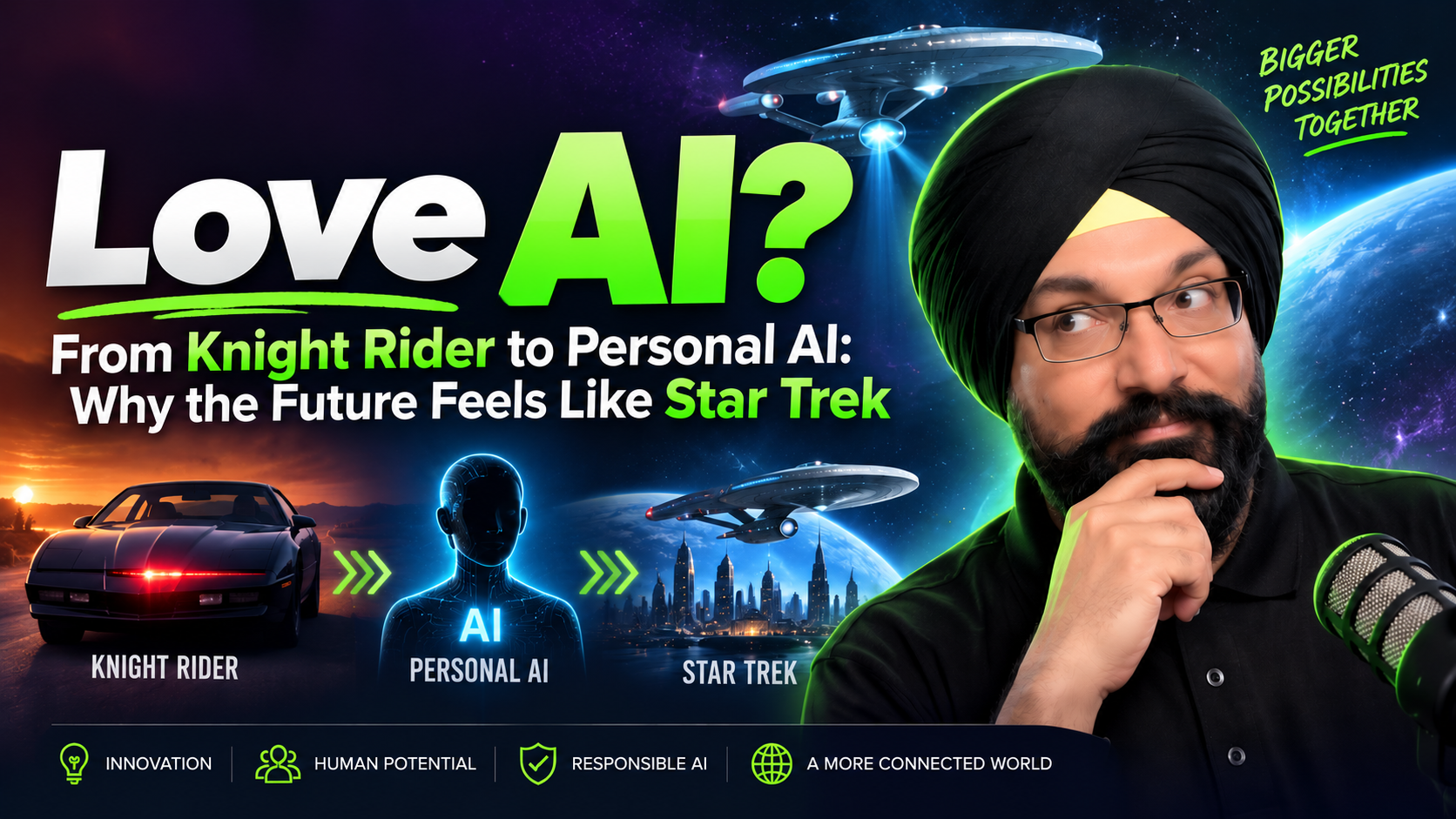
When I was growing up, artificial intelligence wasn’t something we discussed in terms of large language models, agents or automation.
It was KITT from Knight Rider.
It was the computer on Star Trek.
It was talking to technology and having it understand you. Cars that could think. Computers you could have a conversation with. Devices that could translate languages instantly.
It was science fiction.
And yet, increasingly, I find myself looking at what is happening with AI today and thinking:
We’re actually building the future we used to imagine.
That’s both incredibly exciting and, if we’re being sensible about it, something we need to approach with responsibility.
From science fiction to everyday technology
As a child, I loved the idea of technology that could interact with us intelligently.
Think about Knight Rider. Michael Knight didn’t sit down at a keyboard and type instructions into KITT. He spoke to the car.
KITT understood him, responded and helped him.
Or think about Star Trek.
You could simply ask the computer a question. There were intelligent systems everywhere, and one of the ideas I particularly loved was the universal translator.
People from completely different worlds could communicate with each other.
At the time, these ideas seemed fantastical.
Today?
We can speak naturally to AI. We can generate images, music, software and video. We can translate speech increasingly quickly. AI can see what’s on a screen, interpret information and take actions.
We’re moving from AI that simply answers questions towards AI that can potentially do things for us.
That’s a major shift.
Should we be afraid of AI taking our jobs?
Of course, there is another side to this conversation.
Whenever AI comes up, one of the first questions tends to be:
“Is AI going to take our jobs?”
It’s a legitimate concern.
Some jobs will change. Certain tasks will become automated. Some roles may disappear, just as they have during previous technological revolutions.
But I think there’s another question worth asking:
What becomes possible when AI increases what an individual human being can do?
That’s the part I find particularly exciting.
AI can turn ideas into things
I’ve had ideas for software for years.
One example is an event-management platform.
Previously, turning an idea like that into a real product meant having the technical knowledge yourself or finding developers, designers and other specialists.
Then you needed the budget to pay them.
That creates a huge barrier between having an idea and actually testing it.
AI changes that equation.
I’m now able to use AI tools to help me think through problems, write code, troubleshoot issues and build things that previously would have required considerably more resources.
Does that suddenly make me the world’s greatest software engineer?
Of course not.
But it gives me leverage.
And I think leverage is one of the most important ways to understand AI.
AI doesn’t necessarily have to replace your abilities.
It can amplify them.
Creativity without becoming an expert at everything
Music is another great example.
I understand some aspects of music, but I’m certainly not a trained professional musician.
Traditionally, that would limit what I could create.
AI changes that.
I can bring an idea, a concept, some knowledge and my own creative direction, and AI can help fill some of the technical gaps.
Suddenly, the distance between:
“I’ve got an idea for a song”
and
“I’ve made something I can actually listen to”
becomes much smaller.
The same thing is happening with coding, writing, design, video and countless other creative disciplines.
This doesn’t mean expertise stops mattering.
In many ways, expertise becomes even more valuable because the person who understands the fundamentals is better equipped to direct the AI and judge its output.
But AI can dramatically increase what we’re capable of producing.
The future I’m really interested in: Personal AI
There’s another development that fascinates me even more.
Personal AI.
Most of the AI we use today ultimately exists somewhere outside our immediate control. We connect to a service, send it information and receive an answer.
But our personal devices are becoming extraordinarily powerful.
Look at the processing capabilities we’re putting into modern computers and devices, including machines such as Apple’s Mac Minis.
That creates an interesting possibility.
What happens when your AI increasingly runs on your own hardware?
Imagine an intelligent system that belongs to you.
It understands your projects.
It understands how you work.
It learns your preferences.
It can help organise information, create things, research ideas and potentially operate other tools on your behalf.
But importantly, it’s contained within an environment you control.
That’s where the idea starts to feel less like today’s Siri and more like having your own KITT.
Not simply:
“What’s the weather today?”
But:
“Help me accomplish this.”
That’s a completely different relationship with technology.
Could AI finally give us the universal translator?
Then we get to one of my favourite possibilities.
Language.
Imagine putting in an earpiece and simply speaking English while the person opposite you speaks Japanese, Punjabi, Spanish, French or virtually any other language.
You hear them naturally in your language.
They hear you naturally in theirs.
In real time.
No stopping to type something into a translation app.
No awkward pauses.
Just a conversation.
Think about what that could mean.
Travel becomes different.
International business becomes different.
Education becomes different.
Relationships between people from different cultures become different.
Language has been one of humanity’s biggest communication barriers for thousands of years.
AI could dramatically reduce that barrier.
That’s incredibly exciting.
But AI has a yin and a yang
I’m optimistic about AI, but optimism shouldn’t mean pretending there aren’t serious problems.
There are.
Deepfakes are becoming increasingly convincing.
Misinformation can be created at enormous scale.
People’s work can be copied or used without permission.
AI can be used for scams, manipulation and countless other things that don’t benefit society.
Every powerful technology has this duality.
It can be used to create.
It can be used to destroy.
It can connect people.
It can manipulate people.
It can increase human potential.
It can also be misused.
That’s why the conversation around regulation, ownership, transparency and responsibility matters.
But I don’t believe the existence of negative uses means we should stop exploring the positive ones.
What if we focus on what AI can help us solve?
I’d rather ask:
What problems can we solve with this technology?
Can AI help somebody turn an idea into a business?
Can it help scientists analyse information faster?
Can it help a small business compete with a much larger organisation?
Can it help somebody communicate with a person whose language they don’t speak?
Can it give creators new ways to express ideas?
Can it make education more personalised?
Can it help individuals do things that previously required an entire team?
Those are the possibilities I want to explore.
Because ultimately, AI is a tool.
A remarkably powerful tool, yes.
But what matters is what we choose to do with it.
Maybe the Star Trek future isn’t so far away
When I think back to watching Knight Rider and Star Trek as a child, there’s something wonderful about seeing pieces of that imagined future appearing around us.
Talking to computers isn’t science fiction anymore.
AI assistants aren’t science fiction.
Real-time translation isn’t science fiction.
Creating software by describing what you want is increasingly not science fiction.
And genuinely useful personal AI may be much closer than many of us realise.
There will be mistakes.
There will be misuse.
There will be difficult conversations about jobs, ownership, privacy and responsibility.
We need to have those conversations.
But I also don’t want fear to prevent us from recognising the extraordinary opportunity in front of us.
Used thoughtfully, AI can potentially help us create more, communicate better and extend what we’re capable of doing as human beings.
Perhaps that’s the part of the future we should be working towards.
Not AI instead of humanity.
AI that expands human potential.
And if I can eventually have my own version of KITT running locally, helping me build things while a universal translator lets me talk to anyone on the planet…
Well, the kid who grew up watching Knight Rider and Star Trek would be pretty happy.
What do you think?
Do you love the direction AI is heading, or does it concern you?
And if you could have a genuinely personal AI — something that knew how you worked, ran under your control and helped you every day — what would you want it to do?
🎙️ This article accompanies an episode of the Digital Rapport Podcast — Connect, Influence and Inspire in the Digital Age.

Digital Business Coach | Web Revenue Strategist | Award-Winning IT Consultant | Author
Transform Your Skills, Knowledge and Experience Into a Thriving Online Business
Get Expert Guidance and Bespoke Growth Strategies, Meticulously Crafted to Align with Your Individual Journey as a Subject Matter Expert.
With over 18 years of industry experience in business and personal development, I’ve successfully been working with coaches, consultants and authors set up the right systems and implement strategic content strategies to start, grow and scale their businesses online with automation, digital products and services. (To work with Jatinder – click here)