
Listen to the podcast
Most of us were taught that rapport is a skill. Match their posture. Mirror their words. Use the right tone. Ask the right questions.
It works, up to a point. But anyone who has sat across from someone who was “doing rapport” on them knows how hollow it can feel.
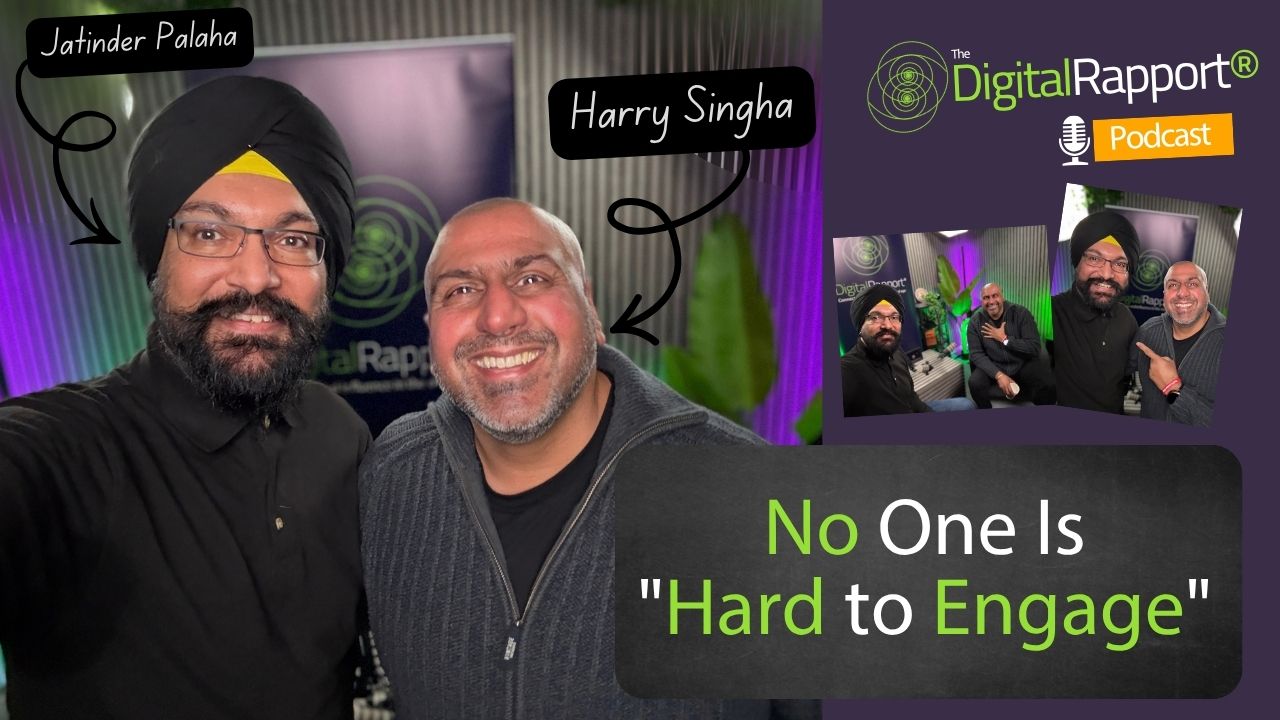
When I sat down in person with Harry Singha for the Digital Rapport® Master Series, I opened the way I always do: what is rapport to you? He didn’t hesitate. “Energy,” he said. Then he went one layer deeper: “vibration.”
Harry is a global speaker, author, humanitarian and creator of the World Class Speaker system. He gave his first professional talk one week after his 16th birthday, in children’s homes in East London. Forty years later he has spoken in more than 200 countries and runs a youth speaker programme reaching 100 countries a year.
What follows are the ideas from our conversation that I keep coming back to. If you coach, consult, lead a team, or simply want to connect better with the people in your life, they are worth sitting with.
Rapport starts with whether you care
Harry works with royalty, CEOs, head teachers, social workers and five-year-olds. He adjusts his words for each of them. But he was clear that the words are the periphery, not the heart of it.
His example stuck with me. When we talk to a baby, we smile, soften and play, because we know the baby can’t understand the words. It reads what we are doing. Then we walk into a meeting with a CEO, freeze up, stop breathing and recite our CV.
The CEO is a human being too. Most just want to know one thing: are you genuine?
Harry’s first rule of connection is blunt. You have to genuinely care about the person in front of you. Everything else, the language, the tone, the body language, sits on top of that. Without it, technique is just performance.
He described it like this. While he is with you, you are the most important person on the planet. If this were his last hour, the most valuable thing he could give you wouldn’t be advice. It would be his full presence.
There is no such thing as “hard to engage”
Around 2000, Harry was running services in East London for young people and adults dealing with substance misuse. His team kept clients engaged when others couldn’t, so a national agency sent someone to find out how.
Official guidance at the time listed “hard to engage” communities, Asian women and young white boys among them. Harry pointed out of his office window at a group of kids leaving school. They were laughing, talking and gathering. They were engaging perfectly well with each other.
The real problem, he said, wasn’t the community. It was that the professionals couldn’t engage with them. Labelling a group hard to engage lets us off the hook. It also shapes how we behave towards them, and they feel it.
The shift is simple and uncomfortable. Stop saying “they are hard to engage”. Start saying “I find it hard to engage with them”. Only then can you do something about it.
This applies far beyond social services. Think of the client you’ve written off as difficult, the teenager who won’t talk, or the audience you’ve been told “doesn’t do” interaction. Harry gets reserved Scandinavian audiences on their feet because he refuses to accept that story before he starts.
KYC: Know You Care
You’ve probably heard the line: people don’t care what you know until they know you care. Harry turned it into a model long before KYC meant banking checks.
Picture standing side by side with someone, with a mirror between you. On their side is CYK: I don’t care what you know. On yours is KYC: they need to know you care. Same letters, reflected.
So how do you show someone you care? You get to know them. Know your client, your customer, your child, your community. And how do you get to know them? You learn their language.
Harry doesn’t mean only words. He means their gestures, their pace, their energy. If someone talks with their hands, you can too. You don’t need to do it perfectly. When he speaks his broken Punjabi with family, they respect him more because he’s trying.
This is where his answer about energy comes full circle. When you communicate the way someone else does, you start to resonate with them. They feel something they can’t quite name. We call it “clicking” or “a good vibe”. Harry calls it vibrational resonance, and it works even over the phone.
He added one caution. This is powerful, and the same principles are used by people with bad intentions. Use it with care, and for good.
When you don’t know what to say, say so
I asked Harry the question I think many people quietly carry: what if I don’t know how to be present?
His answer started at his father’s funeral. He was 18. Relatives were blaming him, consoling him, confusing him. One uncle asked if he was okay, and Harry admitted he didn’t know how to respond. The uncle told him: when you don’t know what to say, say you don’t know what to say.
It made no sense to him then. It became the foundation of his work. By 21 he was chairing the mental health providers across East London, and his biggest fear was getting it wrong for someone.
That pressure to fix things is the interference. It pulls us out of the moment. So he gives people permission to say: “I’m not going to pretend I understand what you’re feeling. I don’t have the answers right now. But I’m here.”
No expectation of anything in return. No expectation on yourself to solve it. Just your full attention.
He links this to speaking through three levels of presentation:
- Re-presentation — a rehearsed script, delivered the same way every time, as an actor would.
- Presentation — a framework you know well, with freedom in how you share it.
- Present — no script. The principles live in your muscle memory, and you respond to the people in the room.
The best speakers, and the best coaches, operate at the third level.
Connection in the age of AI
Ask a teenager what “connection” means and they’ll probably say Wi-Fi. Harry plays on that: the connection that matters most is between “my wife and I”. And the battery that powers real connection is love and presence. You don’t have to go and get it. You already have it to give.
That doesn’t make him wary of technology. He is, in his words, in love with AI. He has built an AI mentor trained on his own frameworks, so young people in his programme can ask questions in their own language, 24 hours a day. For him it’s about serving more people, not just earning more.
He was equally clear about the limits. AI can get the words right, the tone right, and increasingly the body language right. But the output still comes from programming. And like any powerful tool, it amplifies whoever is using it. If you’re doing good, it will help you do great.
He described three kinds of intelligence we can draw on:
- I — your own intelligence: everything you’ve studied and lived through.
- AI — artificial intelligence, which is only as useful as your ability to use it well.
- UI — what Harry calls universal intelligence: the insight that arrives when you are fully present, which no machine replaces.
This is the space Digital Rapport® exists to explore. Technology should give us more room to be human with each other, not less.
It’s not fear of public speaking
Harry saved his strongest point for the end. We’re often told that fear of public speaking ranks above fear of death. He doesn’t believe it.
In his view, most people have been misdiagnosed. What they actually fear is public shaming: being judged, rejected or humiliated in front of others. Confidence training alone won’t fix that, which is why so many people do the courses and still never speak. If the fear is severe, he encourages people to seek proper mental health support. For most, it helps simply to name the real fear.
He told a story about his father calling him besharam, a Punjabi word for “shameless”. As a boy it was meant as an insult. Decades later, it’s what he teaches. When you have a message that matters, step on the stage and serve, without shame.
Remove the interference
If I had to sum up this conversation in one idea, it’s the one Harry kept returning to. Rapport isn’t something you add. More often, it’s what’s left when you remove the interference: the labels, the scripts, the pressure to fix, the noise.
His parting challenge was simple. Reach out to a few people this week and ask what’s on their heart, with no agenda. Then see what happens.
Connect with Harry – https://www.instagram.com/harrysinghaofficial/
Website – https://harrysingha.com/

Digital Business Coach | Web Revenue Strategist | Award-Winning IT Consultant | Author
Transform Your Skills, Knowledge and Experience Into a Thriving Online Business
Get Expert Guidance and Bespoke Growth Strategies, Meticulously Crafted to Align with Your Individual Journey as a Subject Matter Expert.
With over 18 years of industry experience in business and personal development, I’ve successfully been working with coaches, consultants and authors set up the right systems and implement strategic content strategies to start, grow and scale their businesses online with automation, digital products and services. (To work with Jatinder – click here)